Imagine a web designer, caught in the endless loop of manually adjusting layouts, updating styles, and coding intricate elements for a responsive website. Now picture an AI tool stepping in, freeing the designer from these repetitive tasks and speeding up the project completion. This isn’t science fiction—it’s the reality of web design today, as AI moves beyond being a simple assistant to playing a generative and predictive role in the field.
Crucial Insights Gathered
- AI serves as a co-creator, not a usurper in the design sphere.
- Employ AI utilities to streamline the design process.
- Keep investing in human-centric skills that are indispensable to web design.
- Continual learning is vital to stay afloat amidst the evolving AI technologies.
But don’t worry, this isn’t a tale of robots taking over designers’ jobs. Instead, it’s a glimpse into a future where AI and humans collaboratively create exquisite designs. AI’s role in web design is evolving to optimize user experiences, drive design automation, and harness predictive analytics, among other transformative impacts.
This article isn’t about hyping AI’s potential in design—it’s about delving into how AI is practically reshaping the entire web design workflow, from concept to code. So, let’s gear up to explore how AI is turning the traditional norms of web design on their head.
Decoding AI Web Design: A Fusion of Intelligence and Adaptability
AI web design might bring to mind a future where bots have replaced human designers, but the reality is a far cry from this. It’s not all about enhanced speed or passing off mundane tasks to machines. Rather, AI web design is fundamentally about incorporating intelligence and adaptability into the design process. To do this, it uses the potent combination of machine learning and artificial intelligence.
Key elements of AI in web design include data analysis for user behavior understanding, pattern recognition for predicting visual trends, and content generation for creating compelling narratives. Layout creation is another major component – AI tools can generate and suggest layouts based on various factors. Capping it all, there are user behavior predictions that help tailor the user experience to individual tastes and preferences.
This dynamic, adaptable approach catapults web design well beyond traditional design templates. Traditional design is like cooking from a canned recipe; you’re limited by predefined ingredients and steps. AI web design, on the other hand, is like having a master chef who learns your taste preferences and handpicks the freshest ingredients to create a dish tailored just for you.
Remember, AI web design isn’t about rendering human designers obsolete. Instead, it’s about leveraging AI’s capabilities – from data analysis to predictive algorithms – to rethink and redefine the design process. It’s a partnership, where machines and human creativity join forces for optimized, personalized, and intelligent web experiences.
Cornerstones of AI-Driven Web Design
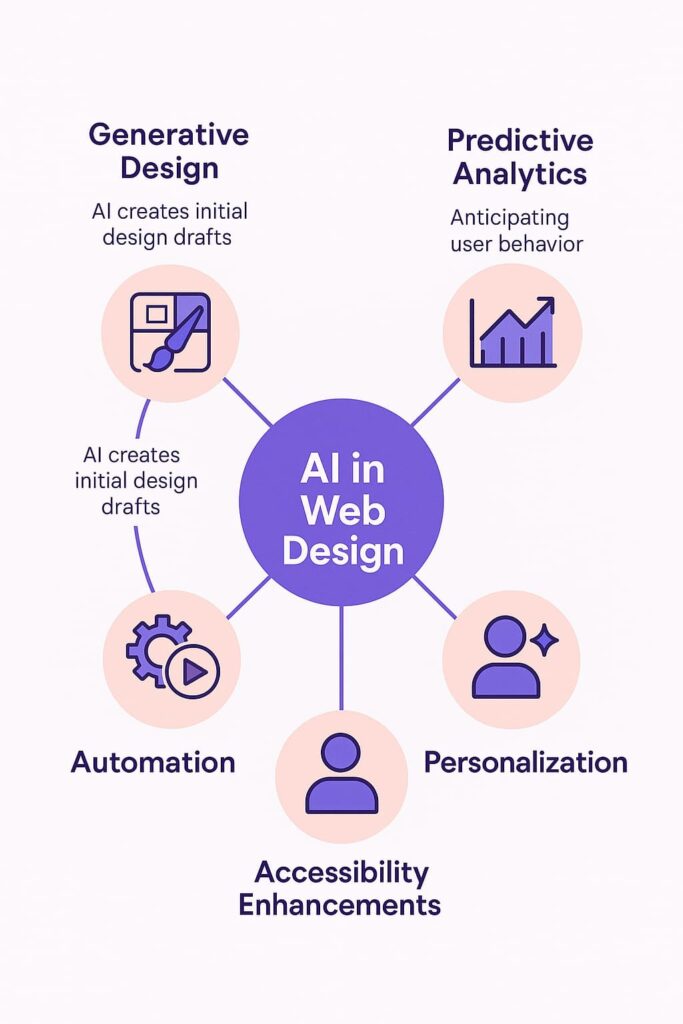
- Generative Design: AI can craft layouts and web components on the fly. Rather than manually creating each item, designers can sit back as algorithms produce varied designs.
- Predictive Analytics: Spotting user behavior trends and predicting subsequent actions become efficient with AI. The ability to anticipate customer needs spells a more personalized user journey.
- Personalization: AI dynamically adjusts content and user interface elements. Your website’s look and feel adapt in real time, delivering a unique experience for every visitor.
- Automation: Coding, testing, and optimization can be fully automated with AI. This reduces the grunt work for developers and helps ensure a smooth, error-free end-product.
- Accessibility Improvements: AI can check for WCAG compliance and generate alternative text. This enables a more inclusive design, accessible to all users, irrespective of their abilities or disabilities.
AI Enabled Workflow: Revolutionizing Web Design Step by Step
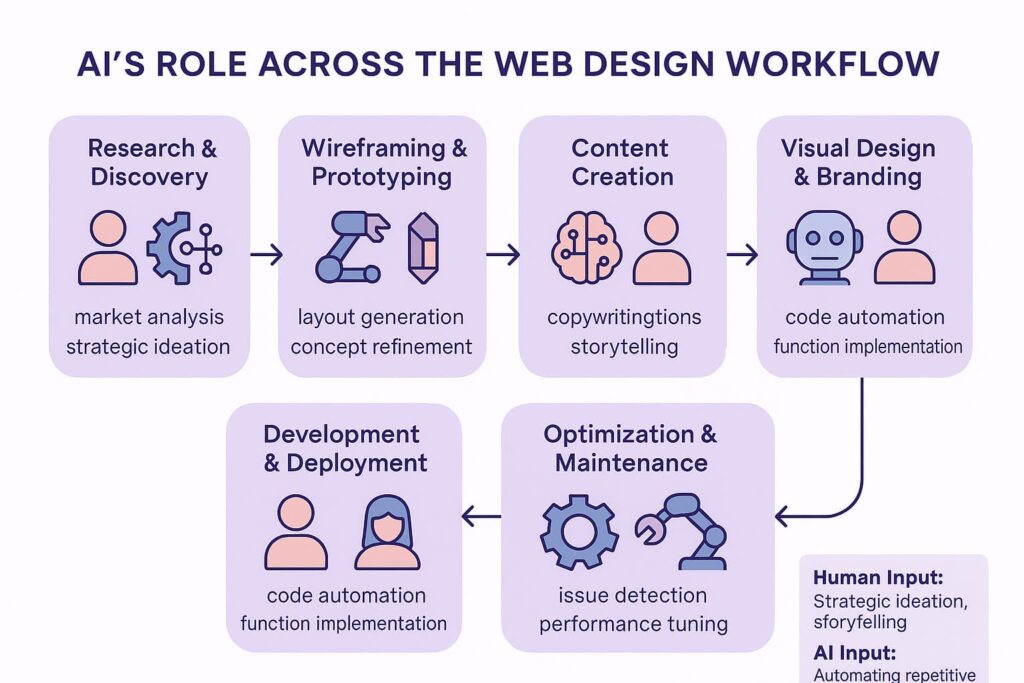
Let’s consider AI as a time-saving assistant in web design, accompanying us through each step of creating a striking, user-friendly site. Beginning with the research and discovery phase, AI delves into data compiled from market trends, competitor sites, and user preferences. It doesn’t just consume this data; it generates actionable insights that shape initial concepts.
Next, we come to wireframing and prototyping. Here is where AI tools come into their own, breathing life into initial layouts tailored precisely to content requirements and user objectives. The design options are rapidly explored, taking the burden of iterative adjustments off the designer’s shoulders.
AI doesn’t stop at layout design. It moves on to content creation, composing engaging headlines and body copy. It even offers up image suggestions to complement the text, streamlining the creative process and offering an added layer of efficiency.
Visual design and branding are next in line. From selecting an appealing color palette to pairing fonts for readability, AI is there. It’s even capable of generating logos, allowing designers to focus on the broader aspects of branding strategy.
The development and deployment phase dramatically showcases AI’s impact on web design. Code generation happens seamlessly, without the undue stress of manual coding. Adjustments for responsive design and deployment pipelines undergo automation, significantly speeding up the process. It is here that AI stands out, bridging the gap between design and functional implementation, encoding clean, semantic scripts for a multitude of frameworks.
Lastly, we have the optimization and maintenance phase. Leveraging AI technology for A/B testing and performance monitoring can spot UX issues right after launch. AI is an invaluable tool in maintaining customer satisfaction and website health long after the designers have moved on to their next project. Thus, AI integrates itself at every juncture of the web design lifecycle, maintaining a futuristic yet grounded impact.
The Toolbox Transformed: AI in Web Design
The rise of AI in web design is not an abstract concept or far-off future—it’s occurring here and now, reshaping the designer’s toolbox. A new generation of practical AI-driven platforms and integrations are catalyzing this change, broadening the scope of what we can achieve.
Centring around different stages of the design process, these AI tools embody diversity. Some offer assistance during the ideation phase, generating design concepts based on user data.
Others streamline code generation, turning visual designs into usable code. With specialization at heart, these AI supplements cater to varying needs, assisting from start to finish, from concept to code.
AI Tools Shaping the Web Design Landscape
What is AI web design if not a skillful blend of technology and creativity? Today, the market offers a variety of AI-powered tools, each fulfilling a unique role in the design process.
AI platforms have systematized layout generation, making the creation of responsive designs a breeze. Specialized plugins for graphics editors like Figma, for instance, utilize machine learning algorithms to offer effective design suggestions.
Need content? AI writing assistants can construct captivating headlines and persuasive text, helping you engage your audience with considerable ease.
Imagery and visual assets are no longer a challenge, thanks to generative AI tools. They can produce stunning graphics tailored to your site’s aesthetic, saving precious time and effort.
Even when it comes to code generation, AI prevails. AI-driven applications convert the visual into the functional, seamlessly writing code snippets that conform to prevailing standards.
These AI tools integrate within your design arsenal, not only assisting in mundane tasks but also enabling greater exploration of innovative paradigms. They streamline workflows, aiding designers in their quest to produce engaging, user-friendly sites. Their potential becomes even more evident when they partner with educational platforms.
For instance, by seamlessly incorporating an AI web design assistant within an educational context, users can analyze design trends, generate mock-ups, and even code snippets for their projects, making the learning process more engaging and efficient.
Embracing AI tools in web design is not merely following a trend – it’s moving with the times. Such devices don’t replace the human touch; they augment it with precision, speed, and invaluable insights. Futuristic? Yes. But remarkably tangible and within reach today.
Debunking the Myth: AI and Design
News headlines may scream that AI spells doom for designers, yet the truth is far from such sensational claims. Scrutinize the role of AI in web design, and a different picture emerges. It’s not about replacement but rather strategic augmentation.
Myth: AI will seize design jobs, ousting humans from the equation.
Fact: AI, in reality, is akin to a helpful assistant, shouldering mundane chores and tedious aspects of design such as tons of code write-ups or routine image optimizations. This automation liberates designers, allowing them the cherished freedom to dive into aspects requiring emotional intelligence and ingenuity.
Let’s face it; AI lacks a quintessential human touch. It can’t imagine, brainstorm, or empathize the way humans can. That’s where we step in. The magic happens when we blend human intuition and AI prowess. It’s when designers orchestrate AI’s capabilities, charting its course based on informed judgment and intuition, that impactful designs come to life.
This isn’t a dystopian battle between humans and machines. Instead, it’s about embracing the alliance of human creatives and AI efficiency to design experiences that truly connect and resonate. After all, isn’t collaboration the essence of the best designs?
A Balanced View: Pros and Cons of AI in Web Design
AI is an invaluable addition to the world of web design, yet it’s not without its challenges or ethical dilemmas. Let’s discuss.
When it comes to upsides, speed tops the list. AI tools are fast, constantly learning from interactions to improve design efficiency. Accompanied by the power of personalization, these tools enhance user experience through data-driven insights, tailoring content to individual preferences. By doing so, AI also promotes accessibility, ensuring that everyone, irrespective of ability, can interact with a website seamlessly.
On the flip side, a heavy reliance on AI could lead to generic designs. Since AI tools learn from existing data, the risk of cloning popular design trends is real. If unchecked, this could compromise the creativity that web design thrives on.
The mention of AI also stirs up job displacement fears. It’s good to bear in mind though, AI is a ‘co-pilot’ in the design process, and human creativity remains of paramount importance.
Data privacy concerns come into play as well. AI tools collect heaps of user data which, if mishandled, could lead to privacy breaches.
Biases from AI’s training data pose another concern, creating designs that unconsciously favor particular groups. The ‘black box’ problem is equally important – if something goes wrong with the AI’s decision, understanding why could be a challenge.
While AI has transformed web design for the better, navigating its downsides responsibly is as essential as unlocking its benefits.
Charting New Paths in a Future Fueled by AI
The AI wave is here, rewriting the rules of the design world. A wave that isn’t looking to sweep humans away but instead propel web designers forward. Continuous learning then morphs from a career-enhancing strategy to a career necessity. New tools powered by AI, once seen as disruptive, become allies, easing workflow while unlocking an exciting realm of possibilities.
This doesn’t mean we are handing the reins to AI entirely. It won’t become the captain steering the design ship. Although AI proves handy in executing structured tasks seamlessly and efficiently, webs of complex problems still need human strategic thought for unraveling. Crafting nuanced narratives and evoking emotional responses, too, falls in our human dominion, where AI may struggle.
Accepting AI as a part of the design toolkit reshapes our perspective. It’s somewhat a balancing act – tipping towards neither unfounded fear nor naive dependence but striving for effective collaboration. A chess game where our human masterstroke guides AI’s powerful moves. It’s the age to not merely adapt but usher in this change strategically, armed with our unique skills and an open mindset.
Looking Beyond: Harnessing AI for the Web of Tomorrow
We’ve traversed the landscape of AI’s transformative impact on web design, peeling back layers of its profound influence. It’s evident that AI is not here to replace us but to elevate our creativity, refine our efficiency, and personalize our user experiences.
Let’s embrace this digital evolution and integrate AI into our practices, not merely to stay in the competition but to redefine it. This is your invitation to shape the web of tomorrow, using artificial intelligence not as a threat but as a catalyst for designing your dreams into reality.