Contrary to common belief, having a singular, potent AI tool is not the be-all and end-all solution for intricate design tasks. Every component of an orchestra plays a unique role, and similarly, each AI model holds its distinct advantage. A symphony results from a variety of instruments laboring in harmony, while an exquisite, nuanced design output emerges from AI models working collaboratively.
This article will guide you on becoming a maestro of orchestrated AI models, blending them seamlessly into your design process. Future AI design doesn’t solely rely on picking the ‘prime’ tool; instead, it zeroes in on the artful fusion of multiple models, which we would now explore further.
A Design Task Reimagined: AI’s Role in Each Phase
Remember the last time you juggled multiple design tasks, from ideation to testing? You probably wished for a hand, perhaps not of a human but an AI. By breaking down a design project into distinct phases, we can better visualize where AI can bring its value.
In ideation, you seek fresh concepts, a task a single AI model can sometimes find overwhelming. However, introducing a multi-AI approach invites a diverse pool of ideas, akin to brainstorming with a global team of creative minds. For mood board generation, you deal with vast visual styles. A single AI model might stumble, but with several AI models, you tap into a broader aesthetic spectrum, similar to having multiple renowned artists on your team.
During wireframing, you aim for both functionality and aesthetic harmony. It’s a task that often pushes a single AI model to its limits. A multi-AI strategy, on the other hand, ensures balance by assigning different responsibilities—akin to an architect and an interior designer working together.
Content creation involves both technical and creative skills. A solo AI model can get stymied. However, when you allow multiple AI models to pool their strengths, it’s like having a writer, a proofreader, and a content strategist delivering high-quality output.
Refinement involves fine-tuning every detail. One AI model can easily miss subtle elements. With multiple AI models, each equipped with its unique strengths, imperfections are minimized with a precision that mirrors a team of meticulous graphic designers.
Lastly, testing ensures your design’s effectiveness. A lone AI model could overlook performance inconsistencies. But by unleashing multiple AI models, you’re harnessing the power of a comprehensive QA team, ensuring every aspect gets scrutinized.
An AI-suitable task isn’t merely about using a tool; it’s about inviting a variety of AI models to your workflow, each rightfully assuming roles based on their strengths. It’s not just about integrating AI models; it’s about leading them, fostering a harmonious collaboration. This idea of becoming an AI design maestro is the main focus of our next sections.
The Chorus of AI Models: Let Their Roles Shine
Let’s put the spotlight on the categories of AI models that can contribute to enhanced design creativity.
1. Generative Text AIs shine when put to work on tasks like copywriting and brainstorming names. They’re akin to having a skilled wordsmith at your fingertips, ready to generate creative text inputs for your design project.
2. Generative Image AIs excel at conjuring up visual concepts and crafting mood boards. It’s like having a visual artist capable of manifesting an eclectic range of visuals to capture the essence of your design vision.
3. Style Transfer AIs take center stage when the call is for applying unique aesthetic filters to the design. They operate like an expert photo editor, adding their touch to every visual they come across.
4. Code Generation AIs serve as the unsung heroes behind UI components and prototypes creation. These AIs code, much like a dedicated developer, to convert design ideas into tangible, functional prototypes swiftly.
5. Data Analysis AIs step in to synthesize user research and spot trends. Picture a seasoned market researcher tirelessly unearthing and analyzing data to guide your design decisions.
Each AI model, performing its unique role, lays the foundation for a linked, multi-modal AI design workflow. They join forces to create a harmonized performance, producing a design masterpiece.
AI Power Duos: Discover Winning Partnerships for Design Goals
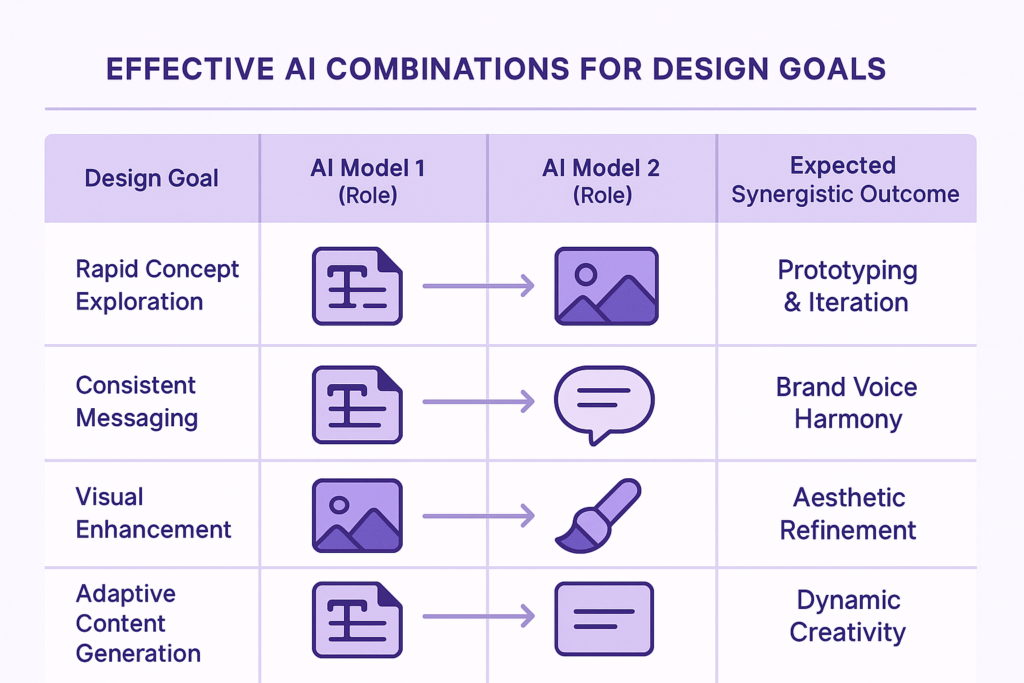
If orchestras rely on each instrument’s unique tone to create harmonious music, so too is the case with combining AI models for satisfying design goals. Some duos resonate better than others, delivering higher impacts. Let’s get acquainted with these perfect pairs.
| Design Goal | AI Model 1 Role | AI Model 2 Role | Expected Synergistic Outcome |
| Rapid Concept Exploration | Midjourney/DALL-E (Initial visuals) | GPT-4 (Concept narratives) | Quicker and diverse ideas generation, robust narrative drafts |
| Brand Voice & Visual Harmony | Style Transfer AI (Visual consistency) | Text Generator AI (Tone-of-voice alignment) | Consistent expression throughout visuals and text, maintaining brand identity |
| User Flow & Microcopy Generation | Code Generation AI (Functional components building) | Generative Text AI (Instruction creation) | Efficient prototype creation with engaging instructions, enhancing user experience |
| Prototyping & Iteration | Generative Image AI (Visual innovation) | Data Analysis AI (Feedback interpretation) | Informed design improvements, saving time in repetitive tasks |
Like a symphony conductor, the trick is recognizing the distinct strengths of each AI model and pairing them to produce the most harmonious outcome for your design goal. And just like in music, there’s room for improvisation and exploration.
A Framework for Multimodal AI Harmony: Your Step-by-Step Guide
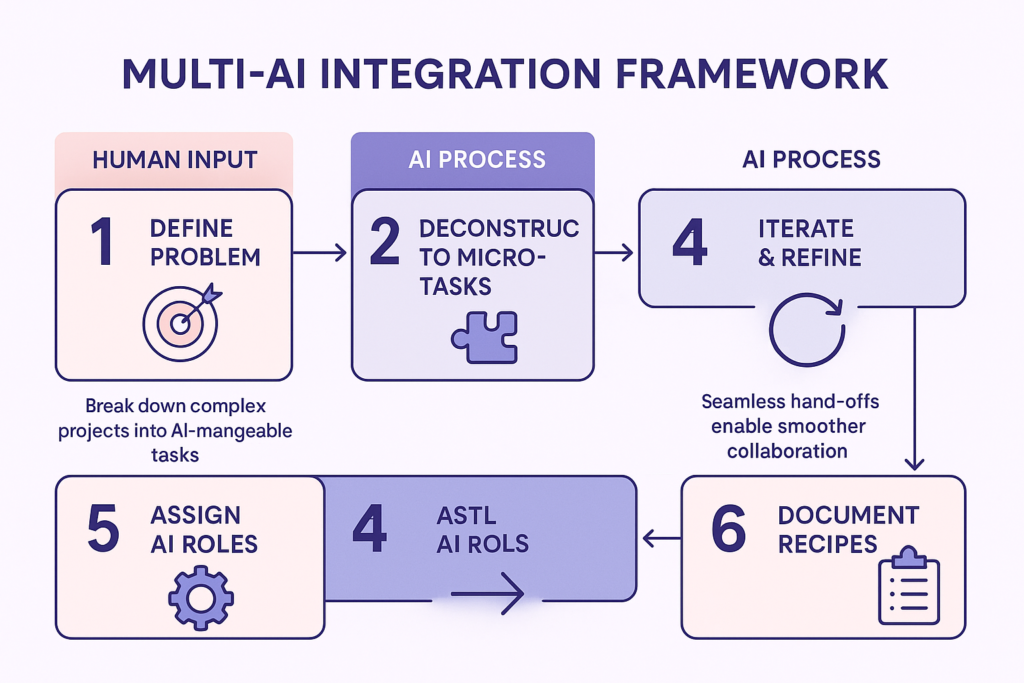
Craving a strategic framework for integrating multiple AI models into your design workflow? Let’s step forward together, from defining the task to streamlining the process for smoother transitions between models. We’ll put multi-modal AI in action to pave the way for innovation in design.
1. Setting the Stage: Defining the Core Problem & Desired Output – Imagine you’re to create an immersive website for a travel agency. Be clear about what you want – an aesthetically pleasing website with unique features, engaging narratives, and user-friendly navigation.
2. Delegating Roles: Deconstructing into Micro-Tasks – Consider each component of your project as an individual role that an AI model can take on. For our travel website, tasks might involve creating prototypes, drafting narratives, generating visuals, or analyzing user experience data.
3. Casting the AI Actors: Assigning AI Roles – You’ve got a suite of AI models at your disposal. Each one excels in different tasks. Given our travel website example, a code generation AI could build the prototype, while a generative text AI crafts captivating narratives.
4. Scene Transitions: Defining Hand-Off Points & Data Formats – Seamlessness between AI models is crucial, as text output from one becomes an image prompt for another. Our code generation AI, for example, might hand off navigation prompts to the generative text AI, using a structured data format.
5. Revising the Script: Iterate & Refine – Successful designs aren’t usually one-hit-wonders. They need iterations. Consider AI outputs as drafts, not the final product. Human insight and creativity should guide edits and refinements.
6. Writing the Director’s Notes: Document Your ‘Recipes’ – Keep track of successful AI chains, effectively turning them into ‘recipes.’ These reusable templates can drastically optimize your design process.
This integration strategy, when applied rightly, can unlock a new level of creativity, broadening the scope of what’s possible in design innovation.
The Toolbox for Advanced AI Integration in Design
Imagine sitting atop an orchestration platform, deftly directing the AI models in your design choir. This majestic outpost isn’t a far-off fantasy—it’s within reach, thanks to a myriad of tools and platforms designed to facilitate multi-AI model integration.
Let’s dissect these artistic aids:
- Prompt Engineering Platforms: These are the key to crack open the door to creativity. With their help, designers can shape, tweak, and tailor AI behavior, enabling them to optimize the output of AI models and adjust them to design needs.
- AI Orchestration Tools: Acting as the virtual conductor’s baton, these tools provide the means to sync multiple AI models into a single, harmonious workflow. They lay the groundwork for a smoother transition from one task or model to another.
- Scripting Environments: Ever considered a Python script performing a waltz with API calls? These seemingly simple languages can choreograph the movement across models, ensuring a steady rhythm of data flow.
While designers are using these tools to disrupt the creative arena, students tangibly experience the magic of multi-modal AI to tackle academic challenges.
For instance, when wrestling with complex Edubrain homework problems with answers crossing subjects, such as math and chemistry, the integrated AI approach can make the difference between a tormenting task and a triumph. It paints a vivid landscape of how multi-dimensional problem-solving thrives in the realm of complex learning domains.
Whether you’re assembling an innovative design or trying to solve problems across subjects, remember—the power lies not in a single model but in the orchestrated symphony of several.
Perils and Practical Solutions in Multi-AI Integration
The road to integrating multiple AI models in a design workflow, while filled with innovation, isn’t without its obstacles. Keep reading as we navigate the bumps and devise strategies to overcome them.
- Enhanced Creativity: A key advantage of multi-AI integration is the elevated level of creativity it fosters. As each AI model specializes in certain tasks, the combined output can result in unique and innovative designs.
- Accelerated Iteration: Multiple AI models facilitate prompt iterations by sharing workload and expediting processes.
- Increased Output Quality: Various AI models can offer a quality boost by focusing on their respective specializations, delivering superior results in their areas of strength.
- Specialized Task Handling: The division of labor among different AI models allows for detail-oriented outputs, providing expertise at every step of the design process.
Against these advantages, few challenges tend to pop up:
- Integration Complexity: Adopting a common data format and API wrappers can help standardize the disparate structures that different AI models bring along, thereby managing the complexity involved in integration.
- Data Consistency Issues: Proper data validation and rigorous checks at each transition point can ensure consistency across AI models.
- Context Loss Between Models: Implementing a meticulously designed hand-off plan with well-defined checkpoints can help minimize the loss of context during model transitions.
- Over-Reliance on AI: While AI models offer significant advantages, human creativity and intuition remain integral to the design process. Balancing AI outputs with human inputs can prevent overdependence on AI.
With careful planning and well-implemented strategies, you can steer clear of these common pitfalls and orchestrate a symphony of AI models for optimal design creativity.
The Critical Piece: Man and Machine in Harmony
As much as a symphony relies on an excellent conductor to bring forth its full potential, the creative AI design workflow needs its human counterpart. This isn’t to reduce powerful AI tools to mere instruments, but to highlight the indispensable role of human vision and decision-making.
A designer’s critical thinking and aesthetic judgment remain the crux of the design process, even while AI models handle specialized tasks. They can mind the ethical considerations, ask thought-provoking questions, and direct AI into fulfilling their vision. Pinch of surprise, the AI aren’t necessarily replacing them, rather, becoming their hands-on assistants.
The designer acts as a strategic orchestrator of this creative symphony. They’re not just standing by and waiting for the AI output but actively guiding the process. It’s their touch of human creativity that turns computations into compelling designs. Isn’t that a testament to the fascinating blend of technology and art!
Core Lessons from Orchestrating Multi-AI Design
Before jumping into your grand multi-AI design project, pack these nuggets of wisdom in your toolkit:
- Grapple with complex design problems by dissecting them into manageable parts for AI.
- Carefully pair each task with an AI model that excels at it.
- Realize that a seamless transition between models cannot be an afterthought.
- Keep in mind that despite AI’s prowess, human judgment will always hold the reins.
- Embrace a cycle of endless tweaking and experimenting, because perfection is a myth in AI’s world.
Set Sail Towards Integrated AI Design
Dabble with the notion that the essence of AI’s prowess rests in the symphony of multiple models. It’s like the wind filling the sails of an ambitious voyage; every gust can propel us further, yet it’s the careful trim and tuck of each sail that truly harnesses the force. In our continuous journey through the ocean of design, it’s high time we steer towards integrated AI workflows.
Think of it as a survival instinct rather than a frivolous pursuit. Soon, being able to expertly orchestrate multiple AI models will graduate from coveted skill to industry norm; marking out the trailblazers amidst the pack.
So, why not usurp convention and experiment with radical new workflows? It’s your turn at the helm—steering AI capabilities towards more innovative designs. Leap forward, try, stumble, learn and chart your own course in this intriguing realm. Remember, you’re not alone in this expedition; don’t hesitate to share your findings and experiments in the comments below, after all, we’re in this together.